The Challenge
Antibody discovery programs often begin with multiple possible paths. Teams may need to compare:
-
-
different species
-
different cohorts
-
different tissue sources
-
different immunization strategies
-
different cell enrichment strategies
-
Testing every path in a full discovery campaign is rarely practical. Resources are limited, timelines are tight, and sample availability may not support broad parallel campaigns. That makes early decisions high-stakes: choosing the wrong sample can cost time, budget, and momentum before full discovery even begins.
The Single Cell Solution
First Look Assay is a low-cost, small-scale antibody screening study performed on multiple samples before a full campaign. Using AbTheneum cell isolation and antibody screening, samples are run in parallel under the intended screening plan so teams can compare outcomes at single-cell resolution. Because antibodies are not sequenced in First Look, the study remains cost-effective while still providing meaningful information about each sample’s response. The final report summarizes hit rate, assay performance, and projected hit count to help teams select the best sample and de-risk downstream discovery.
Highlights
- Compare multiple sample paths before full-scale discovery
- Evaluate individual mAb populations at single-cell resolution
- Run customized screening plans in parallel across candidate inputs
- De-risk assay setup on the most relevant sample first
- Gain time to adjust assays or reagents if optimization is needed
- Support internal decisions with comparative sample data
Problem: Taking on the Challenge
Antibody discovery programs often start with several possible sample paths, but limited time, budget, and sample availability make it impractical to fully screen every option. Teams need an early way to compare samples at the single-cell level and identify the one most likely to support successful full-scale discovery.
Solution: Finding a Better Way
First Look Assay was designed for this early decision point. Instead of committing immediately to a full campaign, teams can screen small aliquots of frozen cells from multiple candidate samples and compare them side-by-side under the intended assay plan. The workflow moves from sample selection to cell isolation, antibody screening, readout, and ranking, helping teams identify the strongest sample before scaling up (Figure 1).
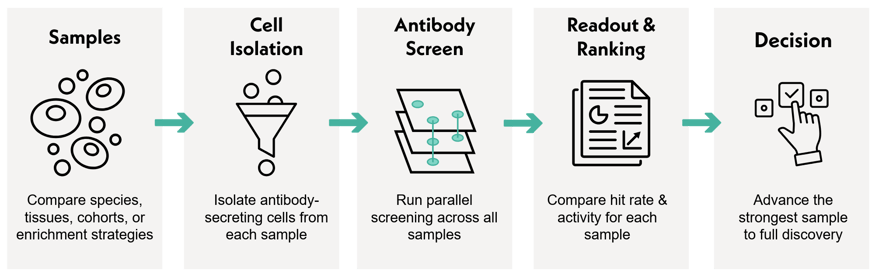
Figure 1. First Look workflow for parallel comparison of multiple samples. Smaller aliquots of frozen cells are screened under the intended assay plan to compare single-cell activity by sample and identify the strongest path for full discovery.
Because First Look does not include sequencing, it offers a cost-conscious way to evaluate which sample is most promising without taking on the complexity of a full discovery campaign. The report focuses on the outputs that matter most for early prioritization:
- single-cell hit rate
- screening profile under the assay plan
- comparative performance across samples
- projected hit count for a full-scale campaign
This gives teams a defensible way to choose where to go deeper, refine the screening plan, and support next-step decisions internally.
Want the one page version?


Impact: What We Achieved
In Figure 2, First Look compared Sample A and Sample B and identified a clear front-runner. Sample A showed stronger performance across total hits, cross-reactive hits, receptor-blocking hits, and benchmark-competing hits, supporting its advancement into full discovery.
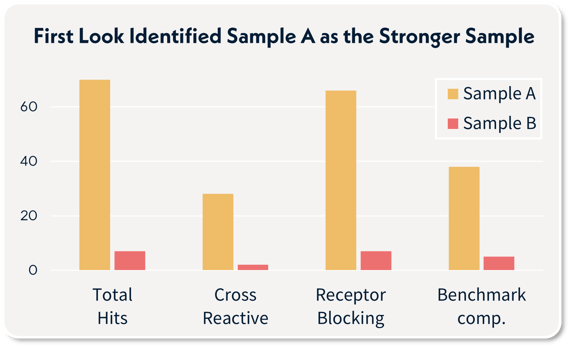 Figure 2. Sample A outperformed Sample B across key screening metrics in First Look Assay,
supporting full-discovery follow-up of Sample A.
This is where First Look creates value. By comparing candidate samples side-by-side at the single-cell level, teams can move forward with a stronger rationale, a better-informed assay plan, and greater confidence in the selected path. The result is a practical way to reduce uncertainty before full-scale discovery.
Talk to us about your samples

-1.png?width=352&name=freezer%20boxes%20in%20-80C%20(1)-1.png)